
What Kitchenware Buyers Really Evaluate When Reviewing Samples
A product sample is more than a physical item.
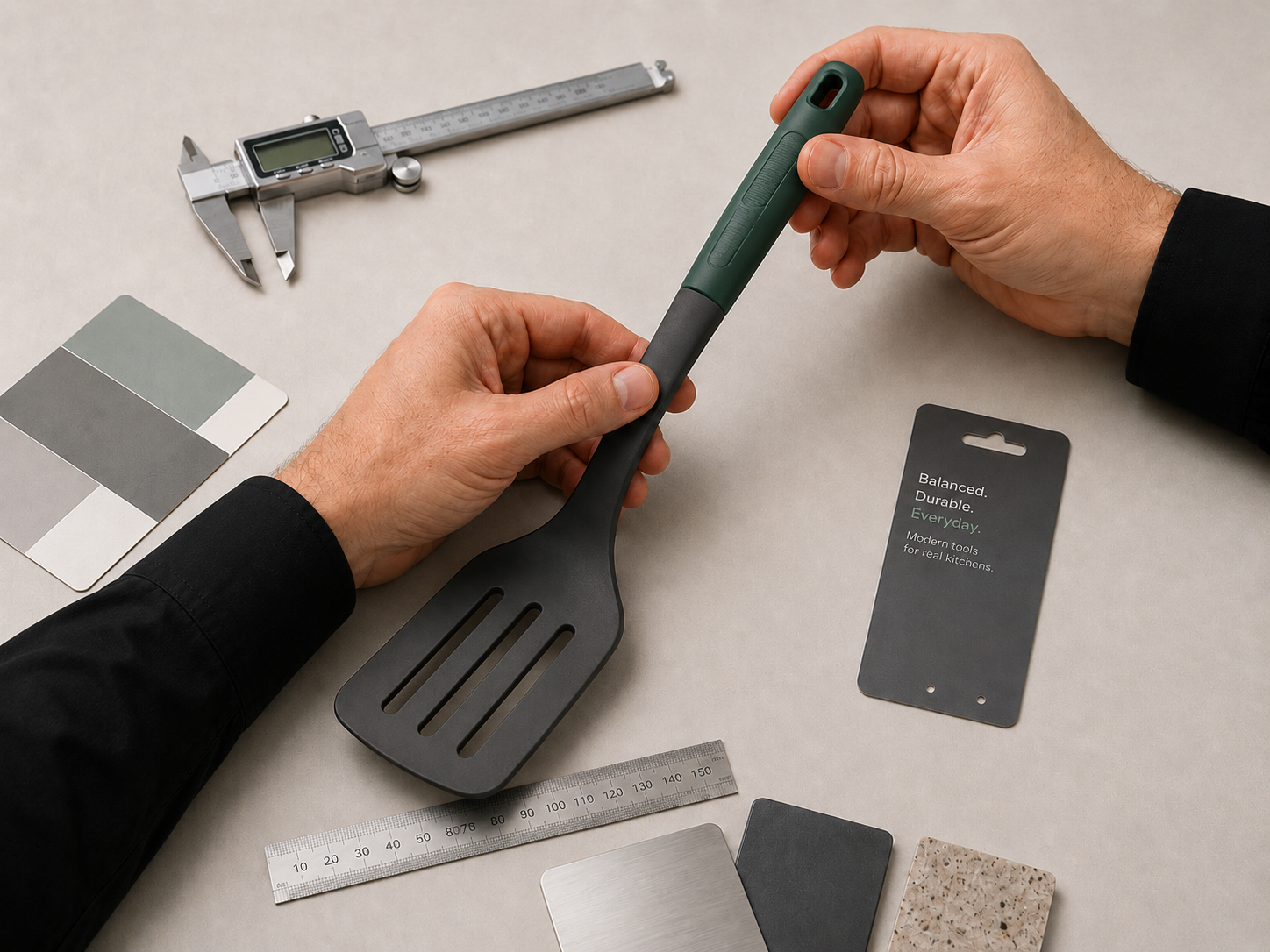 For buyers, it is often the first moment when an idea becomes real. Before that point, the product may only exist as a drawing, quotation, catalog image, 3D file, or specification sheet. Once the sample arrives, the buyer can hold it, test it, compare it, place it back into the packaging, and judge whether it feels suitable for the market.
 For buyers, it is often the first moment when an idea becomes real. Before that point, the product may only exist as a drawing, quotation, catalog image, 3D file, or specification sheet. Once the sample arrives, the buyer can hold it, test it, compare it, place it back into the packaging, and judge whether it feels suitable for the market.
This is why kitchenware sampling plays such an important role in product development.
During a sample review, buyers may not always give long comments. Sometimes they simply pick up the product, feel the handle, check the surface, open and close the mechanism, compare the color, and ask a few direct questions.
But even in this quiet process, they are making important judgments.
For kitchenware brands, retailers, sourcing teams, and private label buyers, the details discovered during sampling can influence much more than one product approval. They can affect whether the buyer continues the project, expands the product range, places a repeat order, or trusts the supplier with future development.
At Dingrow, we often find that sample discussions are not only about obvious defects. More often, they focus on small product signals. These signals help buyers judge whether the item will feel reliable, comfortable, and ready for real kitchen use.
Hand Feel Often Creates the First Impression
Most kitchen tools are judged by hand before they are judged by specification.
A buyer may review the material details, dimensions, and test reports later. But the first reaction often comes from touching the product.
Does the handle feel natural? Is the grip comfortable? Does the surface feel smooth, sharp, slippery, hollow, heavy, or oversized?
This matters because kitchen tools are not only visual products. They are used during cooking, washing, stirring, lifting, peeling, cutting, mixing, serving, and storage. A product may look attractive on the shelf, but if it feels uncomfortable in the hand, the buyer will notice very quickly.
Hand comfort is especially important for frequently used tools, such as:
Peelers
Tongs
Spatulas
Whisks
Graters
Measuring tools
Small ergonomic details can strongly influence the buyer's impression.
A handle edge may feel slightly too hard. A grip may look soft but fail to support the fingers properly. A tool may twist when pressure is applied. A product may look balanced visually but feel awkward during simulated use.
These details may not always cause immediate rejection. However, they become part of the buyer's overall evaluation.
Buyers are often thinking about different real-life users. Someone cooking quickly after work. Someone preparing a full meal. Someone using the product with wet hands. Someone taking the tool in and out of a drawer every day.
A strong sample does not only look acceptable.
It feels believable in daily kitchen use.
Weight Distribution Can Change the Quality Impression
Weight can be measured easily.
Balance is more difficult to define.
Two kitchen tools may have the same total weight, but they can feel completely different when held. One may feel stable and controlled. Another may feel too heavy at the front, too light in the handle, too hollow, or slightly awkward during movement.
Buyers often notice this, even when they do not describe it in technical terms.
A pair of tongs that feels weak at the front may give the impression of poor durability. A spatula with too much handle weight may feel uncomfortable when flipping food. A grater that does not sit firmly in the hand may make the user feel less confident.
This is where kitchen utensil quality goes beyond material thickness, surface finish, or visual design.
Good balance usually comes from several design and manufacturing factors working together:
Material selection
Handle structure
Head size
Connection design
Product length
Intended cooking movement
During kitchenware sampling, buyers often test these points naturally. They lift the product, turn it, tilt it, press the working area, tap it lightly, or imitate the way a customer would use it.
They are not only checking whether the product is strong.
They are checking whether it feels controlled.
For private label kitchenware, this point is especially important. The sample must match the brand's market position and customer expectations. A tool that feels too light may seem low cost. A tool that feels too heavy may feel tiring or unnecessarily bulky.
Good balance is usually quiet.
When it works, people may not mention it. But when it feels wrong, it immediately affects the buyer's confidence.
Color, Surface, and Finish Reveal Production Control
Color is one of the easiest details to notice.
It is also one of the easiest details to lose control of.
During sample review, buyers may compare the product with an approved color standard, Pantone reference, previous sample, existing product range, or brand mood board. From the factory side, a small color difference may seem acceptable. But from a retail or brand perspective, it can be important.
If a silicone spatula needs to match a whisk handle, measuring cup, storage container, or full utensil set, color consistency becomes part of the product identity.
Buyers often check details such as:
Color differences between different materials
Uneven surface texture
Changes in gloss or matte effect
Flow marks, small surface marks, or visible lines
Coating uniformity
Visible seams, rough trimming, or unfinished edges
This is not about unnecessary criticism.
Retail presentation makes differences easier to see. Online product photography can make them even more obvious. If one item in a set looks warmer, shinier, duller, rougher, or cheaper than the others, customers may notice.
Surface finish also affects perceived value.
A matte finish can look modern, but if it marks too easily, buyers may question its durability. Stainless steel can look premium, but uneven brushing or strong fingerprint marks can make the sample feel less refined. Plastic can look clean, but if the surface looks thin, cloudy, or inconsistent, it can reduce trust in the product.
At Dingrow, we often see finish-related comments turn into useful product development direction. Buyers are not always asking for a completely new product. Sometimes they are asking for small refinements that make the sample better match the brand position.
Less gloss.
A more stable color tone.
A smoother connection between materials.
A cleaner edge.
These changes may seem small, but they can improve the entire product impression.
Packaging Also Influences the Sampling Decision
Some people treat packaging as a separate step after product approval.
In reality, buyers often judge the product and packaging together.
A kitchen tool may feel comfortable and look good, but if it sits poorly inside the insert, moves around during transport, or looks crowded in the box, the buyer will notice. Packaging affects retail presentation, shipping protection, shelf appeal, and the customer's first impression.
During sample review, buyers may look at:
Whether the product is held securely
Whether the insert supports the product shape correctly
Whether labels, windows, and display areas show the right details
Whether the package feels too empty or too tight
Whether the customer can remove the product easily
For giftable kitchenware sets, packaging becomes even more important.
A utensil set, measuring cup set, baking tool kit, or cooking tool collection should feel organized and intentional. If the insert bends, the tools overlap awkwardly, or the product moves too much inside the box, the sample may feel less ready for retail.
Packaging also shows whether the supplier understands the sales channel.
A buyer may be considering shelf height, e-commerce shipping, barcode position, hang hole strength, display consistency, instruction layout, or multilingual information. These details may look small, but they help reduce problems later.
For private label kitchenware projects, a well-fitted package can make the buyer feel that the product is close to launch.
Poor packaging fit suggests that more revision rounds may be needed.
And more revisions usually mean more time.
Moving Parts Are Tested Quietly but Carefully
Some of the most important sample checks happen without much discussion.
A buyer opens and closes a pair of tongs. Presses a garlic press. Rotates a can opener. Locks and unlocks a mechanism. Checks whether two assembled parts meet cleanly.
These small actions can reveal a lot.
If a hinge already feels loose at the sample stage, the buyer may wonder what will happen after repeated use. If the alignment is slightly off, they may question tooling accuracy or assembly control. If a locking mechanism feels rough, the product may feel unfinished, even if the design looks attractive.
Products with movement need special attention because they are judged through use, not only by appearance.
Examples include:
Tongs with locking mechanisms
Peelers with rotating blades
Garlic presses
Can openers
Kitchen scissors
Salad spinners
Measuring spoons with sliding parts
A buyer may not use engineering terms. They may simply say, “This feels a little loose,” or “Can we make the movement smoother?”
But that short comment often carries a bigger concern.
Will the customer trust the product?
Will the mechanism remain stable after repeated use?
Will complaints appear after launch?
Will the same issue happen across mass production?
That is why hinge quality, alignment, and movement control can influence bigger sourcing decisions than many suppliers expect.
Sampling Is Mainly a Test of Confidence
Most buyers do not expect the first sample to be perfect.
Sampling is part of product development. Adjustments are normal. In many cases, the buyer is not looking for perfection at the beginning. They are looking for signs that the supplier understands the product, listens carefully, and can improve the sample in a practical way.
This is why product development feedback during sampling is so important.
When a buyer comments on handle comfort, weight balance, color matching, packaging fit, or mechanism smoothness, they are not only pointing out defects. They are showing what matters to their brand, their customers, and their retail channel.
The supplier’s response matters.
Can the issue be understood correctly?
Can the improvement be made without creating another problem?
Can the next sample show visible progress?
Can the product stay cost-aware while still feeling reliable?
At Dingrow, we see sampling as the bridge between a product idea and real kitchen use. A sample should not only pass a checklist. It should help the brand judge whether the product can perform in daily use, look right on the shelf, and remain consistent during mass production.
That is where buyer confidence begins to grow.
Sometimes it comes from a handle that feels more comfortable.
Sometimes it comes from a cleaner surface finish.
Sometimes it comes from packaging that finally holds the product properly.
Sometimes it comes from a hinge that feels stable after repeated testing.
These details may appear small from the outside.
But buyers notice them.
And very often, these are the details that decide whether one sample becomes one order, and whether one order becomes a long-term product line.


